
M. Reeves Had Taste and Now I Have Their Blazer
This $3 double-breasted blazer was wedged between two moth-eaten trench coats at a Goodwill in Southeast Portland. It’s charcoal wool, probably late ’80s based on the cut and the union label stitched inside the inner pocket. The shoulder pads are aggressive. The lining is slick burgundy polyester with one small tear near the hem. There’s a faint dry-cleaning tag clipped to the collar that says “M. Reeves.” I don’t know who M. Reeves was, but they had taste, and now their blazer lives in my closet next to a bleach-stained Hanes tee and a pair of cargos I cut into shorts last summer.
I haven’t bought a new piece of clothing in over two years. Not because I’m trying to perform some grand mission. I just stopped seeing the point. Everything I want already exists in a thrift store, a Depop listing, or a donation bin I haven’t gotten to yet. The secondhand market has more range, more history, more texture, and more weirdness than anything a retailer could dream up for a new season. And right now, with the 80s power-dressing and indie-sleaze revival tearing through feeds and trend reports, the proof is sitting in bins and on wire hangers for under ten bucks.
Why the 80s Revival Belongs to Secondhand First

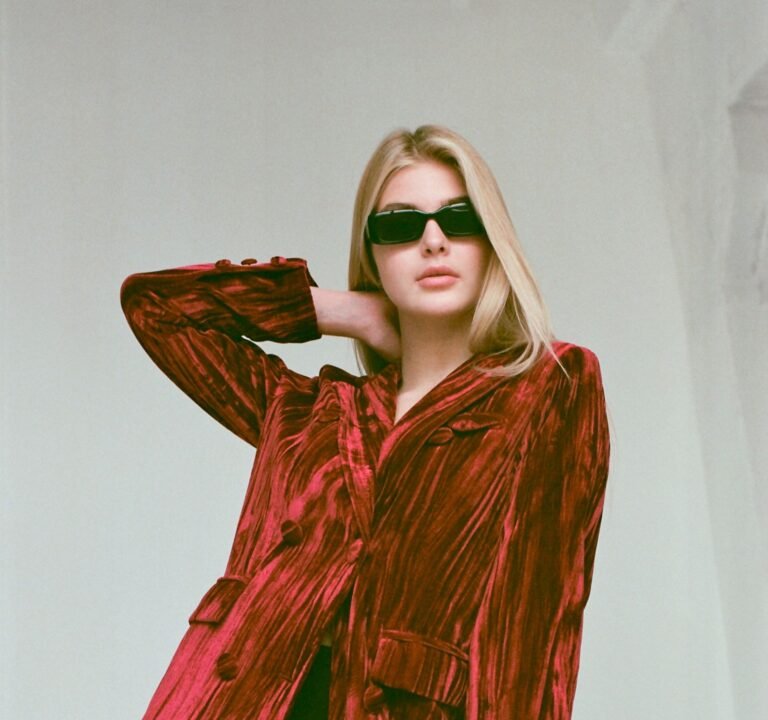
Here’s what’s happening. Power dressing is back. Structured shoulders, leather everything, brooches pinned to lapels, belts wide enough to double as armor. The indie-sleaze side of it is creeping in too: messy layering, worn-in textures, an intentional refusal to look too put-together. You’ve seen the mood boards. You’ve scrolled the hashtags. And if you’ve been paying any attention, you’ve noticed that the people doing this well aren’t buying it new.
They’re pulling it from the racks at their local thrift. They’re sorting through bins at the Goodwill Outlet by the pound. They’re searching “80s blazer structured” on Depop and filtering by price low-to-high. The 80s already happened. The clothes already exist. Buying a brand-new padded-shoulder blazer from a fast-fashion chain in 2025 because the trend came back around is like printing a photocopy of a photocopy. You lose everything that made the original interesting.
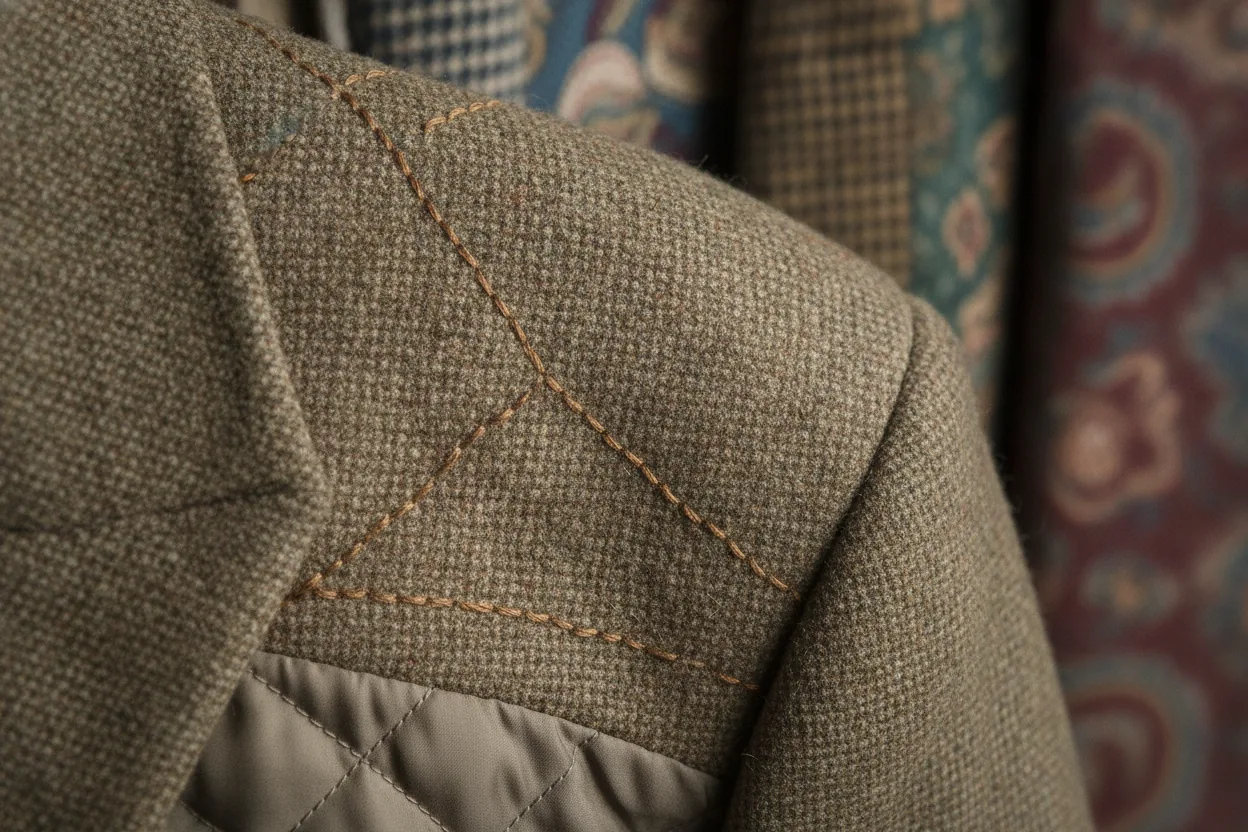
The M. Reeves blazer in my closet weighs more than anything I’ve tried on in a store in years. The wool has a density to it. The construction is different. The lapels roll instead of lying flat. The buttons are actual horn, slightly yellowed. None of that gets replicated when a brand knocks off the silhouette for $39.99 in a poly blend. You get the shape, sure. But you lose the thing that makes it worth wearing.
And this is where I always land when I think about buying new versus buying secondhand. The argument isn’t really about the environment, even though yeah, the environmental math is obvious. The argument is simpler than that. The secondhand version is better. It’s a better object that tells a better story and fits differently because it was made differently. When you’re trying to pull from an era like the 80s or the indie-sleaze moment of the late 2000s, the real article will always hit harder than the knockoff.
Structured Shoulders Without the Halloween Problem
The biggest fear people have with 80s dressing is looking like they’re wearing a costume. That’s fair. If you walk out of the house in a full 1987 ensemble, head to toe, you’re going to look like you’re headed to a themed party. The shoulder pads, the bold jewelry, the cinched waist, the big hair energy. Taken literally, it’s a lot.
But nobody who’s actually good at this is taking it literally. The younger thrifters driving this revival are cherry-picking. They’re grabbing one piece, maybe two, from the era and then grounding everything else in something modern, something personal, something that doesn’t scream “I watched Working Girl last night.”
The Goodwill find, for example. I wear it open over a ribbed tank top that’s two sizes too big, with the sleeves shoved up past my elbows. The shoulder pads give me this silhouette that feels strong without being stiff, like the blazer is doing the posture work so I don’t have to. Below that, it’s just wide-leg jeans I hemmed too short and a pair of beat-up New Balance 550s I’ve had for three years. Nothing else in the outfit says 80s. The blazer does all the talking, and because it’s surrounded by stuff that’s clearly just my daily rotation, it reads as personal instead of performative.
That’s the trick. One strong vintage piece. Everything else is just you. The structure of the blazer becomes a frame, not a costume. And the beauty of thrifting it is that the blazer already has the right kind of wear on it. The edges are slightly softened. There’s a tiny pull in the wool near the left cuff. It doesn’t look like it just came off a rack because it didn’t. It looks like somebody wore it, and now you wear it, and that continuity is what keeps it from tipping into costume territory.
A second way in: skip the blazer entirely and start with a thrifted leather vest over a plain white tee. The shoulders still get structure from the vest’s cut, but the bare arms keep it grounded in the present. Add a wide thrifted belt over the tee and you get the cinched-waist silhouette without committing to anything that reads as period cosplay.
Or go the other direction. A military surplus jacket with epaulets, something olive drab and boxy, layered over a slim black turtleneck. The proportions are 80s-adjacent (big on top, fitted underneath) but the palette and the source material pull it away from any single decade. You’re borrowing the architecture of 80s dressing without photocopying the mood board.
Leather and Brooches Are Doing Identity Work
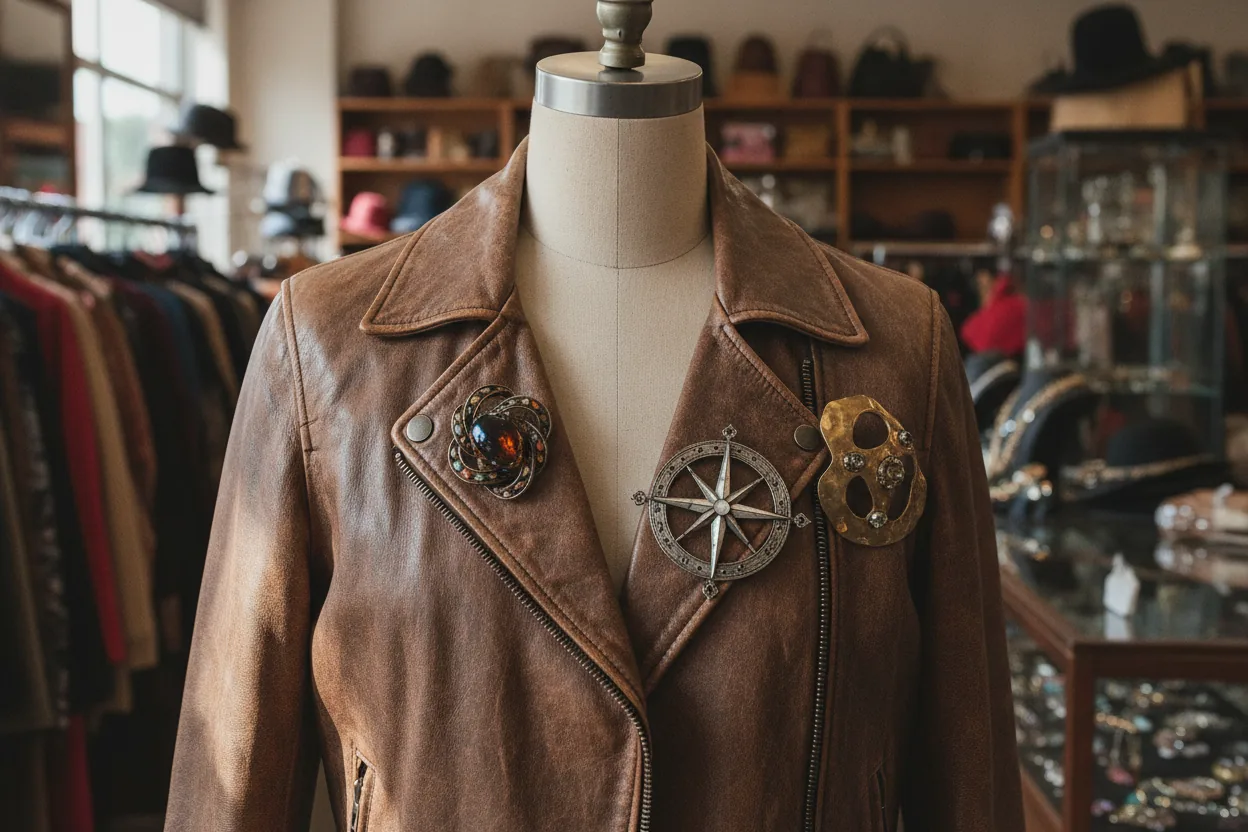
Beyond the blazers, the other pieces fueling this revival are leather jackets, statement brooches, and accessories that are frankly too big. And all three of these categories are where secondhand absolutely dominates.
Leather jackets are the easiest example. A broken-in leather jacket from a thrift store has creases in the elbows, scuffs on the cuffs, maybe a zipper that sticks a little. That’s not a flaw. That’s the whole point. A $12 leather jacket from a Salvation Army with actual patina will outperform a $200 new one every single time because the patina is what makes it look real. You can’t fake twenty years of someone riding a motorcycle or walking to the train in February. The leather remembers.
I found a cropped black leather jacket at a church rummage sale in Milwaukie for $5. The lining was partially ripped out, and someone had stuck a Ramones patch on the back with fabric glue that was peeling. I pulled the patch off, left the glue residue because honestly it looked cool, and sewed in a scrap of flannel as a replacement lining. That jacket now sits in the rotation next to the M. Reeves blazer, and they serve totally different moods, but both of them do the same thing: they give the outfit a backbone without asking me to commit to a full era.
Brooches are the sleeper hit of this whole revival. A vintage brooch on a blazer lapel is one of the lowest-effort, highest-impact styling moves you can make. I’ve got a small collection now, all thrifted, none over $3. There’s a gold-toned abstract shape, like a melted Brancusi sculpture, that I pulled out of a jewelry dish at an estate sale in Sellwood. It looks like it sat on a department store counter in 1986 waiting for someone’s aunt to buy it on impulse. There’s a silver Celtic knot I found in a Goodwill accessories bin, tarnished almost black on one side, the kind of thing someone’s grandmother probably pinned to her cardigan for Sunday mass for twenty years before it ended up in a Ziploc bag of donated jewelry. And there’s a tiny enamel cat with one rhinestone eye missing that I bought at a garage sale for fifty cents and pinned to a denim jacket collar for no reason other than it made me laugh.
The point is, brooches let you mark a piece as yours. You take a blazer that could read as generic or too period-accurate and you pin something unexpected to it, and suddenly it’s a conversation piece. It’s not 80s power dressing anymore. It’s your version of it. And because brooches at thrift stores cost less than a coffee, the barrier to entry is basically nothing.
Oversized accessories follow the same logic. Wide belts, chunky chain necklaces, big geometric earrings. All of this stuff is swimming in thrift stores because it was mass-produced in the 80s and early 90s, then fell out of fashion, then got donated in waves. The supply is massive. The prices are low. And the styling impact is huge because one oversized gold chain over a plain white tee does more for a fit than an entire new outfit from a mall store.
The Hunt Is Part of the Look Now
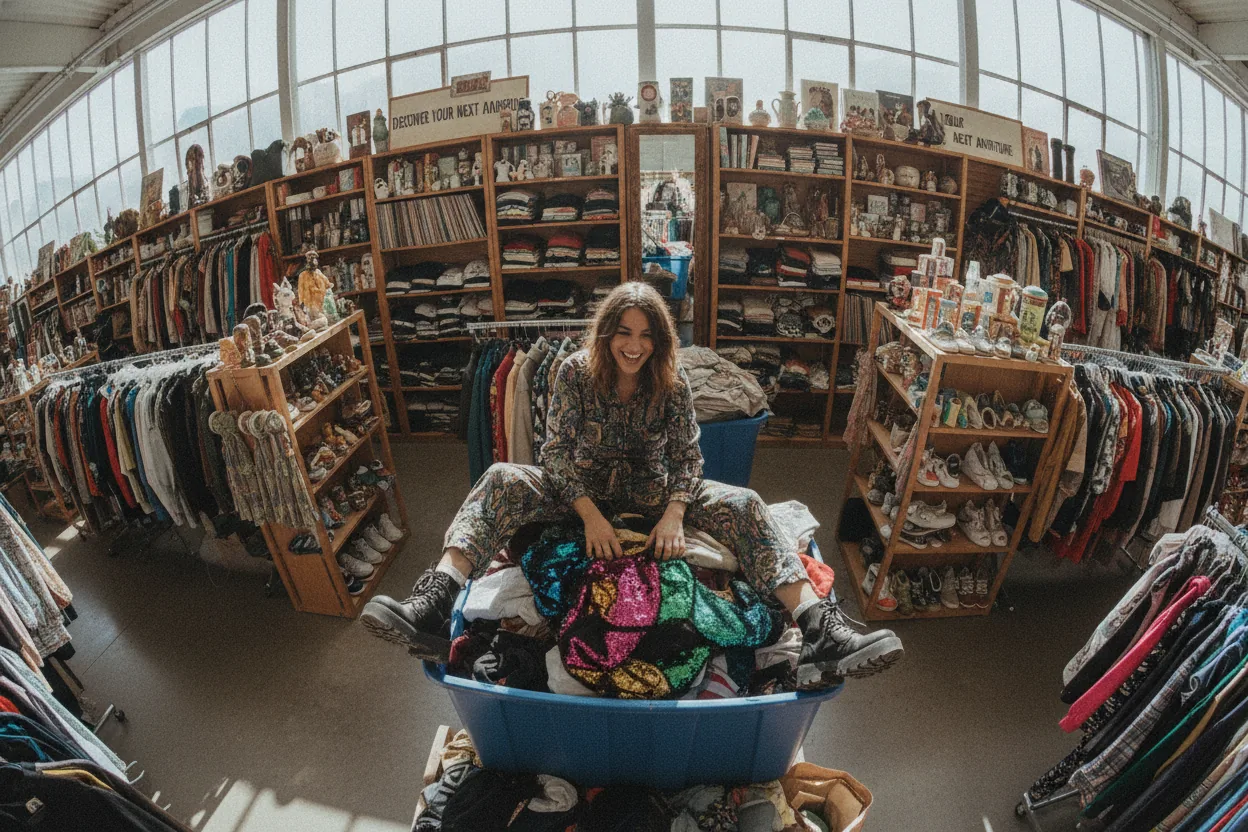
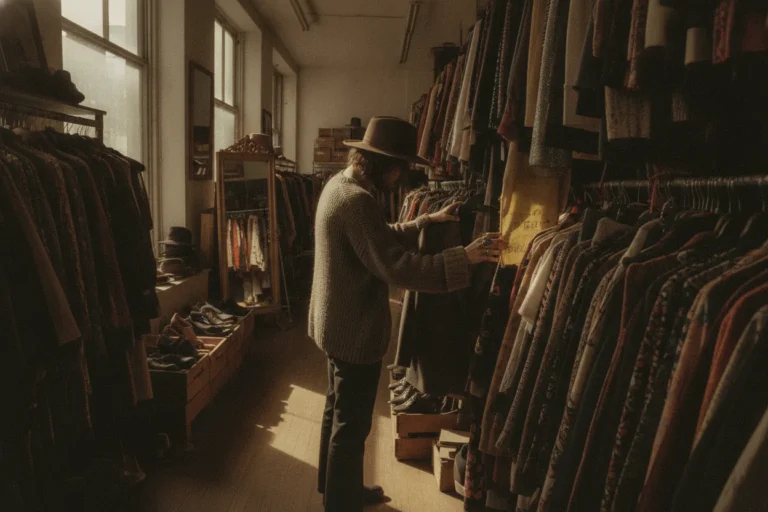
Something shifted in how people talk about this stuff online. It used to be that you’d show the outfit. Now you show the receipt. You show the rack. You show the moment you pulled the piece out of the bin and held it up to the fluorescent light and said “oh, this is it.”
The priced thrift haul is a whole format now. People on TikTok and Instagram are filming themselves walking through Savers or Deseret Industries, pulling pieces off the rack, flipping the price tag to the camera. $4 blazer. $2 belt. $6 leather jacket. The total at the bottom of the video is always absurdly low, and the fits they build from those pieces are always better than anything you’d see in a lookbook.
This matters because it redraws the line between wearing a trend and actually inhabiting a look. When someone posts a structured blazer with the caption “$5 at my local Goodwill, check the seams before you buy,” they’re not just showing you a jacket. They’re showing you a skill. They’re showing you that they know how to read fabric weight, check construction, spot real wool versus poly blend by touch. That knowledge is part of the flex.
And honestly, that’s one of the strongest arguments against buying new. When you buy new, the only skill involved is having a credit card. When you thrift, you develop an eye. You learn what decades feel like in your hands. You start recognizing when a garment was made with care versus made to hit a price point. That knowledge compounds over time, and it makes every subsequent thrift trip more productive.
Secondhand Beats New Because the Flaws Are Features
Let me talk about the M. Reeves blazer’s flaws for a second. There’s the lining tear. There’s a slight discoloration on the right sleeve, maybe a water stain that someone tried to treat. One of the inside pockets has a small hole in the corner. The shoulder pads are maybe a quarter inch uneven, left to right.
None of this matters. None of it is visible when I wear the blazer. And the stuff that is visible, like the slight softening of the wool’s nap on the elbows, actually makes the piece better. It gives it a lived-in quality that a new blazer would take years to develop, if it ever developed it at all, because most new blazers aren’t made from wool that ages well. They’re made from materials designed to look good on the rack and fall apart in six months.
This is the core of why secondhand beats buying new, especially for pieces from specific eras. The 80s produced garments with structure and weight. The construction was different: shoulder pads were sewn in, not glued; linings were full, not half; seams were finished. When you find one of these pieces at a thrift store, you’re getting something that was built to last, has proven that it can last, and now costs less than a sandwich.
Compare that to the new version. A brand sees the 80s trend coming back, produces a padded-shoulder blazer in a lightweight poly blend, sells it for $60, and it hits the landfill in eighteen months. You paid more for a worse product that won’t survive long enough to develop character. The secondhand version already has character. It already survived. It’s been tested.
Making 80s Thrifting a Habit, Not a Phase
If this revival has you wanting to start hunting for structured pieces, here’s how to make it stick instead of treating it like a one-weekend thing.
Go to thrift stores on weekdays, early. The weekday morning drop at most Goodwills and Savers is when fresh donations hit the floor. Weekend crowds are bigger, and the best stuff moves fast. Tuesday at 10 AM is your friend.
Learn to check construction before you check the tag. Flip the garment inside out. Look at the seams. Are they finished or raw? Is the lining intact? Are the buttons sewn on with shank or flat? These details tell you more about the quality of the piece than any brand name will. That $3 blazer with union-made construction and horn buttons is worth more than a $3 blazer with a designer label and plastic buttons.
Don’t shop for a specific item. Shop for a feeling. If you go in looking for “a charcoal double-breasted blazer with padded shoulders,” you’ll leave empty-handed and frustrated. If you go in looking for “something with structure that makes me stand up straighter,” you’ll find it in places you didn’t expect. Maybe it’s a blazer. Maybe it’s a leather vest. Maybe it’s a military surplus jacket with epaulets that you’d never considered before.
Try stuff on over what you’re already wearing. Seriously. Walk into the thrift store in your normal fit and layer potential finds over it. If the blazer works over your hoodie, it works. If it only looks good over a silk blouse you don’t own, put it back. The goal is to integrate, not to build a separate wardrobe for a separate personality.
Hit the accessory bins every single time. Brooches, belts, chains, earrings. These are almost always priced under $5, sometimes under $1, and they’re the fastest way to shift the energy of a piece you already own. A plain black blazer becomes something entirely different with a vintage brooch on the lapel. A leather jacket changes character with a wide belt cinched over it. These small additions are where personalization happens, and they cost almost nothing.
Keep a running note on your phone of what you’re looking for and what you already have. Not a spreadsheet, just a messy list. “Need a wide belt, brown or black.” “Have three blazers, don’t need another unless it’s cropped.” This keeps you from buying duplicates and helps you stay focused when the racks are overwhelming.
Wash or dry clean everything before it goes in your closet. Thrifted garments carry smells, sometimes stains you didn’t see in store lighting, and occasionally surprises in the pockets. I once found a movie ticket stub from 1994 in the breast pocket of a tweed blazer. That was a good surprise. The mystery stain on the collar was less good. Cleaning first saves you from wearing something out and realizing halfway through the day that it smells like a stranger’s attic.
The Real Case Against New Is Already Hanging on a Wire Hanger
The 80s revival is real. The indie-sleaze thing is real. And the fashion industry is going to try to sell you new versions of all of it. They’re going to mass-produce structured blazers and faux-leather jackets and oversized gold jewelry and price it all at a markup and call it a trend.
Don’t take the bait.
The originals are already out there. They’re sitting in thrift stores and vintage shops and donation bins and estate sales, priced at a fraction of what the knockoffs cost, built better, worn in, and waiting for someone to give them a second life. M. Reeves’s blazer didn’t need to be reproduced. It needed to be found. It needed someone to see past the moth-eaten trench coats on either side of it, check the seams, feel the weight of the wool, and recognize that this was the real thing for three dollars.
That’s the case against new. Not that new is morally wrong. Not that you’re a bad person for buying it. Just that it’s unnecessary. The good stuff already exists. It’s cheaper, it’s better made, and it comes with a history that makes it yours in a way no retail purchase ever could. The shoulder pads are already there. The patina is already there. The story is already there.
You just have to go find it.