That $3.50 Vest Started a System I Can’t Buy New
I was three months into a dead zone where nothing in my closet felt like me. Not the jeans I’d been rotating since sophomore year, not the oversized band tees I thought were personality enough, not the docs I’d beaten half to death. Everything looked fine. Nothing looked like mine. Then I pulled a women’s cropped velvet vest out of a Goodwill bin in Tempe for $3.50, tried it over a white ribbed tank, and something clicked. Not because the vest was special in some objective sense. It was slightly faded, missing a button on the bottom, lined with this weird copper-colored satin that had a small tear near the tag. But it did something none of my other clothes did: it started a conversation with the rest of my wardrobe. It forced me to rethink how I layered, what I paired with what, and why I was dressing the way I was in the first place. That vest didn’t save a fit. It started a secondhand style personal brand I didn’t know I was building. And buying thrifted is how I keep that system alive.
Secondhand Style Isn’t Shopping, It’s Authoring
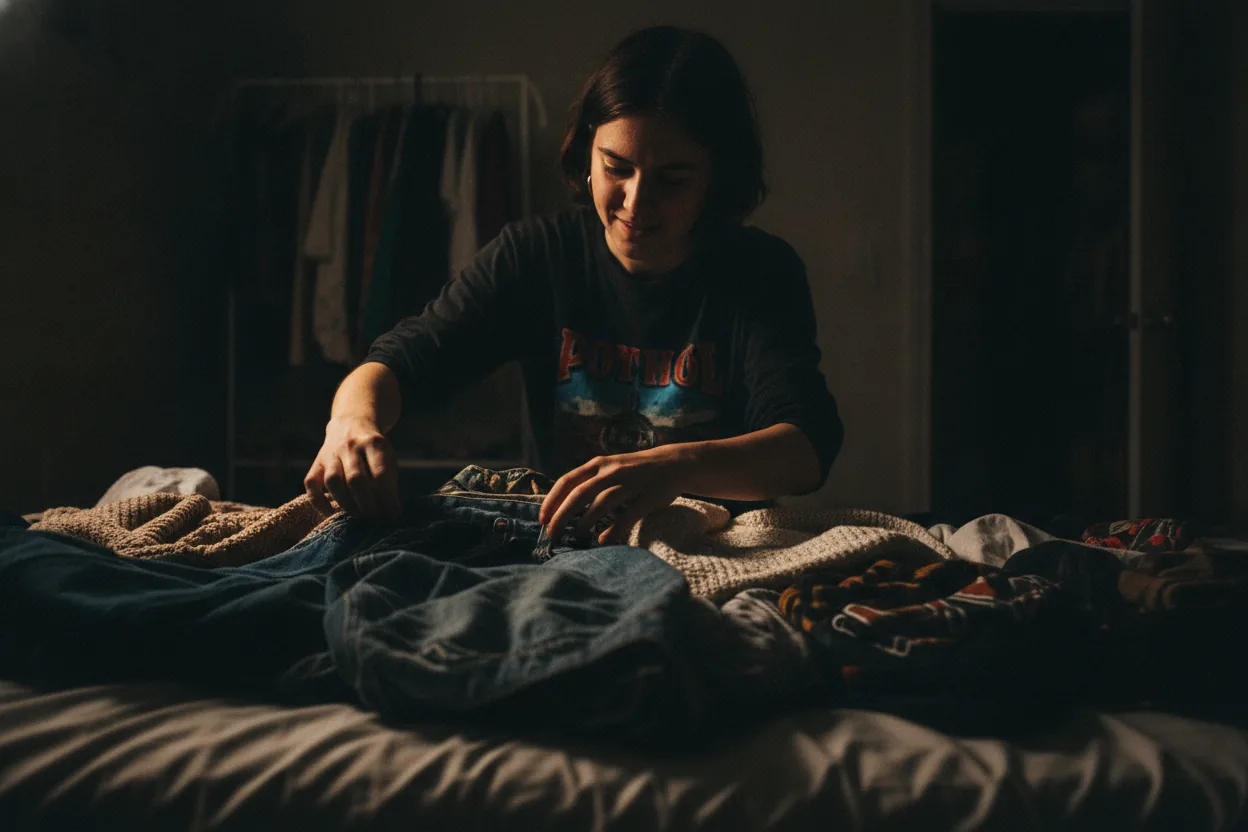
Here’s what nobody tells you about thrifting once you get past the haul phase: it stops being about finding good deals and starts being about building something that’s yours. Not yours like you own it. Yours like you invented it. The difference matters.
I’ve been buying almost exclusively secondhand for about four years now. Started because I was broke. Stayed because I realized I was assembling something I couldn’t get anywhere else. Not a wardrobe. A language. My own visual shorthand that people started recognizing before they recognized my face. And I’m not alone in this. A 2026 study published in the *International Journal of Consumer Studies* by researchers Vladimirova, Iran, and Zemke found that young consumers aren’t just hunting for cheap clothes anymore — they’re using pre-owned pieces for economic practicality and identity expression at the same time. The search for specific thrifted items works as self-presentation, a way to stand apart from mass-produced fashion. That tracks hard with what I see on Depop, on thrift TikTok, in the bins every Saturday morning. People aren’t just looking for a good shirt. They’re looking for the right shirt. The one that fits the visual logic they’ve been building piece by piece.
I call it the “build your own label” thing because that’s literally what it feels like. When I thrift, I’m not grabbing random stuff that looks cool in isolation. I’m casting for a very specific production. I know my silhouettes. I know my colors. I know that if something doesn’t work with the rust-and-cream-and-black palette I’ve locked in, it’s not coming home with me, even if it’s a dollar. I know I want structure on top and loose below, or the reverse — but never matched looseness everywhere. These aren’t rules I learned from a trend report. I wrote them myself over dozens of thrift runs and hundreds of try-ons in fluorescent-lit changing rooms that smell like dust and old detergent.
One-of-One Pieces Kill the Copycat Problem
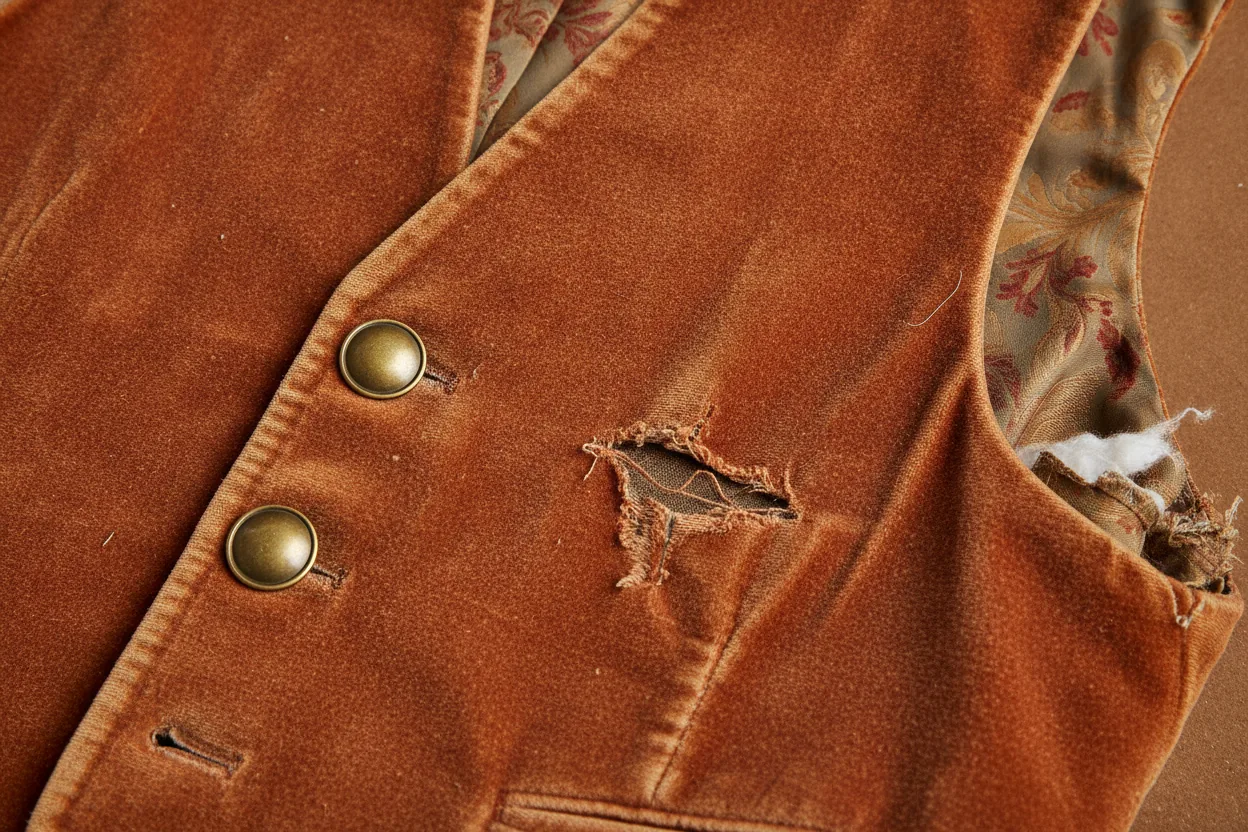
The velvet vest is the perfect example of why one-of-one matters. You can’t go online and order it. You can’t find it at a Zara. It doesn’t have a product page. It exists once, in my closet, with its missing button and its torn lining and its weird copper guts. And that means when I wear it, nobody else is wearing it. Full stop.
This is the part that gets undersold when people talk about thrifting. Yeah, it’s cheaper. Yeah, it keeps stuff out of landfills. But the real power move is that secondhand pieces are almost always unrepeatable. Discontinued cuts, dead brands, vintage runs from factories that closed in 2004, one-off donations from someone’s aunt’s closet cleanout. Every piece has a serial number of one. When Shein drops a trendy top that sells 200,000 units in a week, wearing something that literally cannot be duplicated is a flex that no amount of money can replicate. You can be rich and still look like everyone else. You can be broke and look like no one.
I found a pair of wide-leg wool trousers at a Savers in Mesa last November. $5.99. No brand tag — it had been cut out. Dark charcoal with a faint pinstripe so thin you only see it in direct light. The waist was a half inch too big so I took them in myself with a basic running stitch on the inside. Nothing fancy. Those pants get more comments than anything I’ve ever worn. People ask me where I got them and I say Savers and they look at me like I’m lying. But that’s the thing: the fact that they can’t go buy the same pair is exactly what makes the pair worth something. Not in resale value. In identity value.
The Gap Between Buying New and Building Something Real
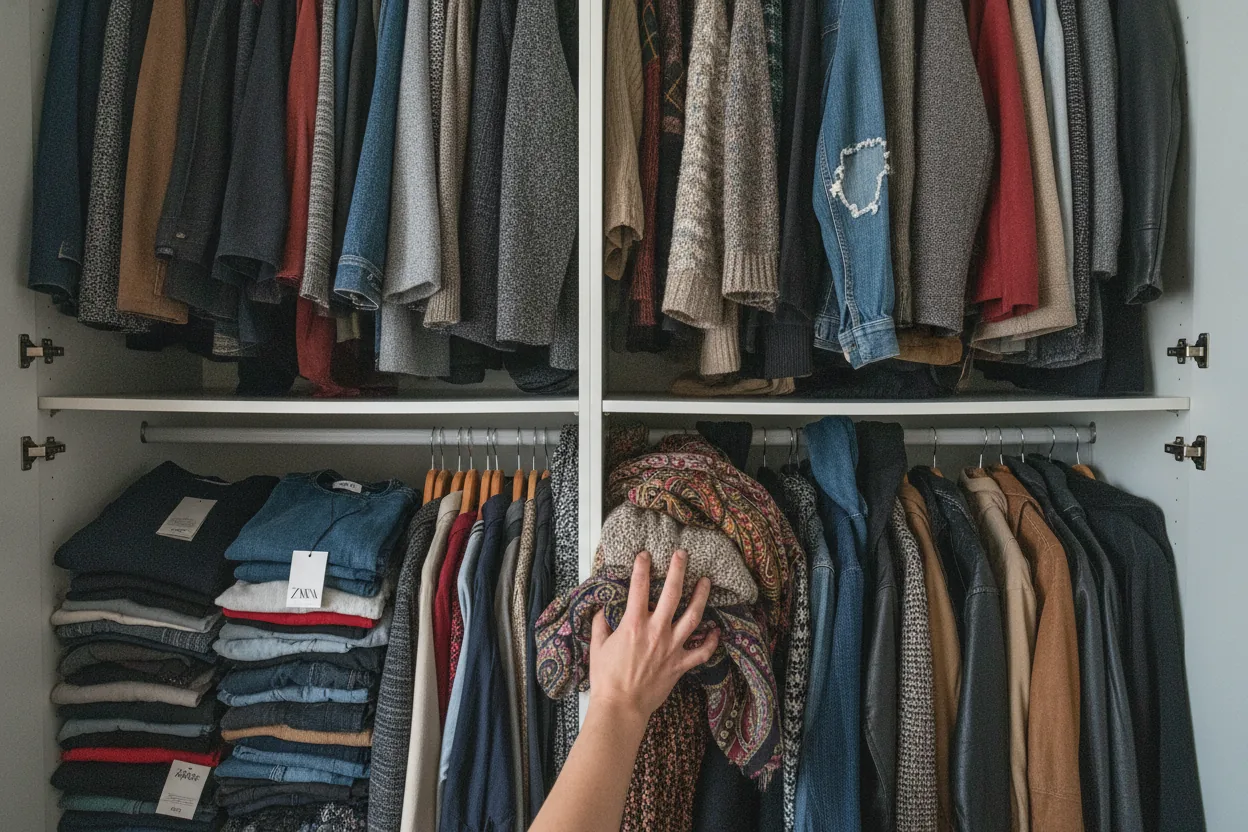
Let me break down why thrifting works better than buying new for building identity, and I’m not going to lecture you about the planet because you already know.
I spent two years before my thrift phase buying from big retailers — H&M, Uniqlo, whatever was on sale at Nordstrom Rack. And the weird thing was, the more I bought, the less I felt like I had a style. Because I was choosing from a menu someone else wrote. The colors were decided in a boardroom eighteen months ago. The cuts were tested in focus groups. The “styles” were trend-forecasted by people whose job is to make sure millions of units move. I wasn’t expressing myself. I was selecting from a pre-approved list of expressions. That’s not identity. That’s a multiple choice test.
Thrifting blew that open. There is no menu. There’s a chaotic, unorganized, half-ugly pile of someone else’s past, and you have to pull meaning out of it. You have to see a shape in the noise. You have to know what belongs in your world and what doesn’t, and you have to make that call in real time with no algorithm feeding you suggestions. That process builds something. Over time, it builds taste so specific that your closet starts looking like a mood board with a thesis statement.
The cost thing matters too, obviously. I’m not going to pretend it doesn’t. That velvet vest was $3.50. The wool trousers were $5.99. A raw silk button-down I found at a church rummage sale in Scottsdale was two dollars. Two. Dollars. For raw silk. If I’d tried to build this same visual identity buying new, I’d be thousands deep. Thrifting lets you experiment without bleeding money. You can take a risk on a weird piece because if it doesn’t work, you’re out four bucks, not forty. That freedom to experiment is how you actually develop a point of view. You try stuff. Some of it’s trash. Some of it becomes the centerpiece of everything you wear for six months. But you can only afford to take those swings if the price of failure is basically nothing.
The Vest’s History and Why Flaws Are the Point
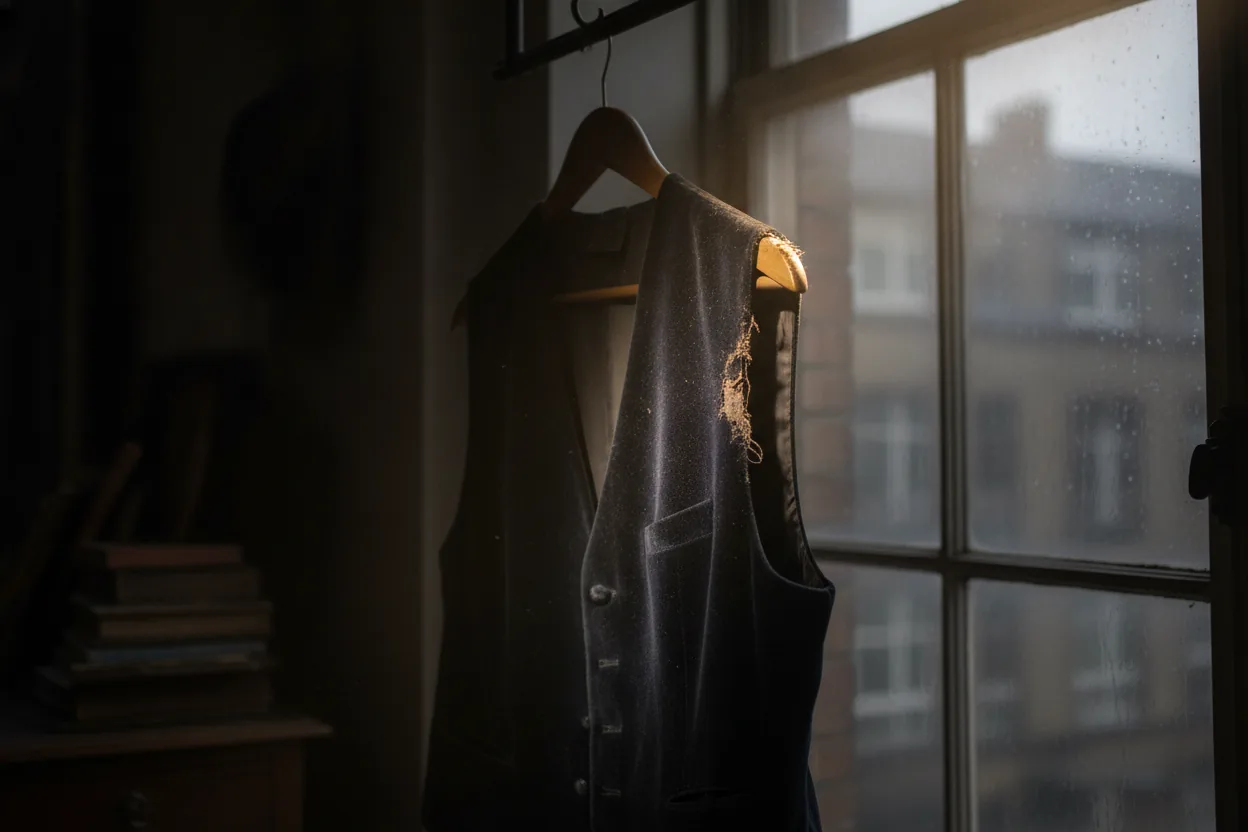
Let me talk about the vest’s flaws because I think this is where the “build your own label” mentality separates real thrifters from people who are just shopping for discounts.
The missing bottom button. The torn lining. The slight fade on the left shoulder where it probably hung in someone’s closet near a window for years. These aren’t problems. They’re provenance. They tell me this thing had a life before me. Someone wore it. Someone stopped wearing it. It passed through hands, sat in a donation bin, got sorted onto a rack between a XXL Hawaiian shirt and a child’s communion dress, and waited until I showed up.
I didn’t fix the button. I didn’t fix the lining. I left them. Those marks are part of why the piece feels real. New clothes don’t have history. They have packaging. They come wrapped in tissue paper and smelling like a factory, and the moment you put them on, you’re the first chapter. That can feel good. But it doesn’t feel like anything yet. Pre-owned pieces arrive mid-story. You’re picking up a narrative that already started. That gives them weight.
The one thing I did change was the fit. It ran slightly long in the torso for how I wanted to wear it, so I hemmed it up about an inch and a half using iron-on hem tape I already had from a previous project. Cost me nothing. Took ten minutes. Now it hits right at my belt line and works with high-waisted pants and tucked-in tees exactly the way I imagined. That tiny adjustment turned a good find into a signature piece. And that’s the difference between thrifting and just buying pre-owned. Thrifting is active. You’re not a consumer. You’re a collaborator.
Thrift Flipping as Personal Styling, Not Just Repair
This gets at something I see blowing up all over thrift TikTok and Depop right now: thrift flipping isn’t being treated as repair work anymore. It’s being treated as styling. As vision.
There’s a creator I follow — @oldgalsclub on TikTok — who approaches thrift flips exactly this way. Not fixing clothes, but redirecting them. She bought a floor-length denim skirt from a Salvation Army for $4, cut it into an asymmetrical midi, added a raw hem, and wore it with combat boots and a cropped cardigan. She didn’t “fix” the skirt. She reimagined it. She took an object with one intended use and gave it a new job inside her visual system. The before-and-after content she posted got thousands of saves because it wasn’t just a clever alteration. It was proof of a specific aesthetic intelligence. She saw something no one else saw in that skirt, and she executed on it.
That’s what I mean by “build your own label.” A label isn’t just a logo. It’s a coherent vision expressed through consistent choices. When you thrift-flip, you’re designing. You’re making creative decisions about length, proportion, texture, and context. You’re taking raw material and turning it into something that communicates who you are. That’s what designers do. The only difference is you’re doing it with a $4 starting point and a pair of fabric scissors instead of a studio in Milan.
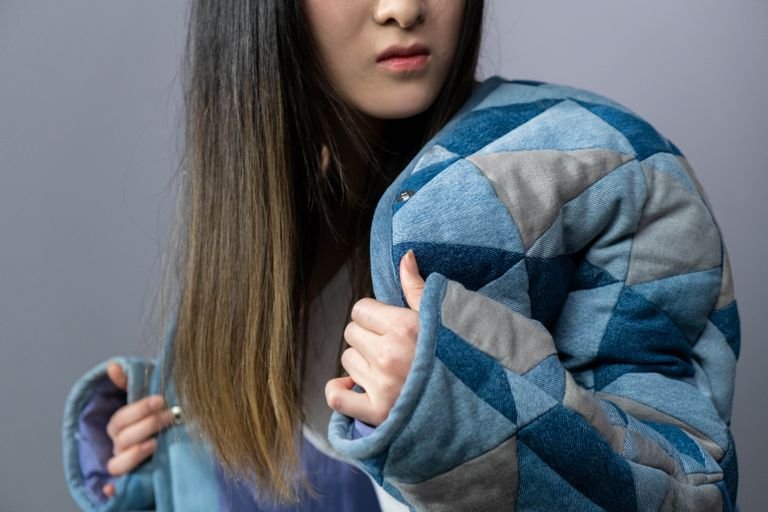
I’ve done this with a bunch of my pieces. Turned a men’s XL corduroy shirt into a shacket by cutting the bottom hem into a slight curve and rolling the sleeves permanently with a few stitches. Took a thrifted silk scarf — $1.50 from an estate sale — and turned it into a neck piece I tie over plain crewnecks. Small moves. But they compound. Over time, your closet stops looking like a collection of random finds and starts looking like a line. Your line. With no middleman, no brand deal, no trend cycle dictating what’s in or out.
Identity Over Trends: The Real Flex
The trend cycle is a trap and I think more people are figuring that out. When everyone’s wearing the same wide-leg jeans because TikTok said so, and then six months later everyone’s back to skinny because some other algorithm shifted, you’re not developing style. You’re being steered. The clothes change but you stay the same: reactive, waiting for someone to tell you what’s next.
Secondhand style flips that on its head. When your wardrobe is built from thrifted one-of-ones, you can’t follow trends even if you wanted to. The pieces you own are too specific, too weird, too personal to map onto whatever’s trending this quarter. And that’s freeing. It means your style has to come from you. From your eye, your references, your willingness to wear something that doesn’t look like anything on the Explore page.
I’ve been wearing that velvet vest for eight months now. It hasn’t “trended.” It’s not going to. But it’s become part of my visual identity to the point where friends reference it when they describe my style. “You know, that vest thing you do.” That’s worth more than any trend. That’s recognition. That’s someone associating a piece of clothing with you specifically — not with a brand, not with a season, not with an influencer. With you.
The same *International Journal of Consumer Studies* research found that authenticity, resourcefulness, and individuality are becoming key style signals among Gen Z. Not “I got the bag everyone wants.” More like “I built something you can’t buy.” The status game is changing. The flex isn’t access to expensive stuff. The flex is a point of view so locked in that people can identify your outfit choices from across a room.
Making Thrifting a Habit That Builds Your Label
So how do you actually do this? How do you go from casual thrifter to someone whose secondhand wardrobe functions like a personal brand?
First, you need anchor pieces. These are the items that define your visual identity. For me it’s the vest, the wool trousers, the raw silk button-down. I didn’t find all of these at once. They accumulated over months. But each one passed the same test: does this feel like it belongs in my world? Not “is this a good deal?” Not “is this trendy?” Does this belong in MY world? If yes, it comes home. If no, it stays on the rack, even if it’s fifty cents.
Second, you need self-authored rules. Write them down if you have to. Mine are simple. Palette stays within rust, cream, black, and olive. Structure on top, drape below — or the reverse. Nothing logo-heavy. Nothing that screams a specific decade unless it’s a deliberate contrast piece. Textures matter more than patterns. These rules aren’t permanent. They shift. But at any given time, having them means I’m not just grabbing randomly. I’m editing with intention.
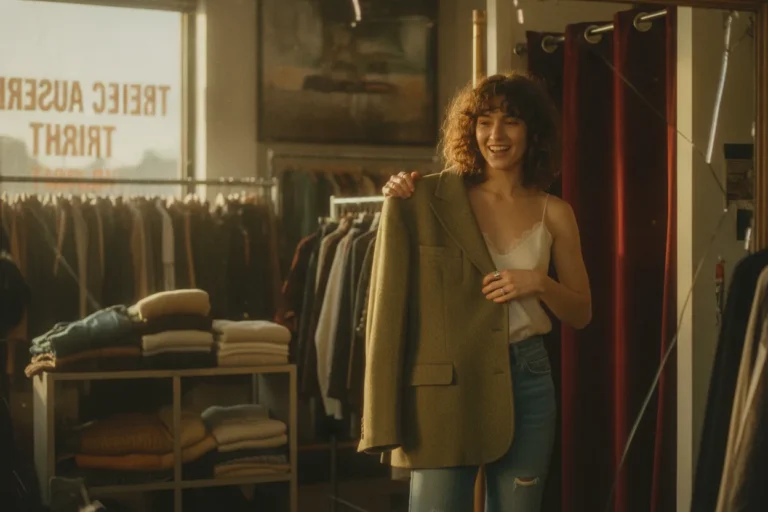
Third, go to the same spots consistently. I have three thrift stores and two resale shops I rotate through every week. I know their restock days. I know which one gets better denim, which one prices vintage too high, which one has the best odds on weird formalwear. That knowledge is an edge. It means I’m not wandering blind. I’m hunting with a map.
Fourth, learn one alteration technique. Just one. Hemming is the easiest. If you can shorten a pair of pants or a shirt or a skirt by even an inch or two, your hit rate on thrift finds doubles instantly. So many pieces are almost right but not quite, and a simple hem turns almost into exactly. Iron-on hem tape costs like three dollars at any craft store and requires zero sewing ability. That’s your entry point.
Fifth, document what you build. Not for clout, though clout’s fine too. For yourself. Take photos of your fits. Look at them over time. You’ll start seeing patterns. You’ll notice which pieces recur, which silhouettes you default to, which combinations feel most like you. That pattern is your label. It’s emerging whether you name it or not. Paying attention to it just helps you refine faster.
The shift happening right now isn’t about thrifting getting popular. It’s been popular. The shift is about what thrifting means. It’s not a budget hack anymore. It’s not a sustainability project with a halo. It’s a creative practice. A way to build an identity out of pieces that can’t be replicated, can’t be mass-produced, can’t be trend-cycled into irrelevance. Every thrift run is a design session. Every weird find is raw material. Every fit you put together from $3 and $5 pieces is a statement that says: I don’t need your label. I built my own.
That velvet vest with the missing button and the torn lining and the faded shoulder? It’s worth more to me than anything hanging in a store right now. Not because it’s rare in some collector sense. Because it’s mine in a way that new clothes never could be. I found it, I altered it, I integrated it, and I wear it as part of a system I authored from scratch. No brand did that for me. No trend told me to. I just knew it belonged, the same way you know when a word fits a sentence. That’s the case against new, right there. New can’t give you that. New can only give you what everyone else already has.