Everything I Wear Orbits a $1.49 Bin Brooch
I was standing in the back of a Goodwill outlet in Portland, the kind with the big blue bins where everything’s sold by the pound, and I’d been digging for maybe forty minutes with nothing. My hands were dusty. My back hurt. I was ready to call it. Then my fingers hit something cold and sharp under a pile of stained tablecloths, and I pulled out an opulent vintage brooch the size of my palm. Gold-tone, maybe brass, with a cluster of deep red stones fanning out like a starburst. Fake? Probably. Old? Definitely. It had a patina that you can’t manufacture and a pin clasp that felt like it could survive another fifty years. I paid $1.49 for the weight. That brooch didn’t just save the trip. It saved the whole direction my wardrobe was heading. I’d been stuck in a loop of plain oversized tees and wide-leg jeans, which I love, but I felt like I was disappearing into my own clothes. That single find pinned to the collar of a thrifted men’s oxford shirt turned a nothing outfit into something people stopped me about on the street.
This is what’s happening right now across thrift stores, Depop, Whatnot live sales, and the bins. People aren’t looking for a full outfit anymore. They’re looking for that one thing that IS the outfit.
Why Opulent Vintage Is Spiking Right Now
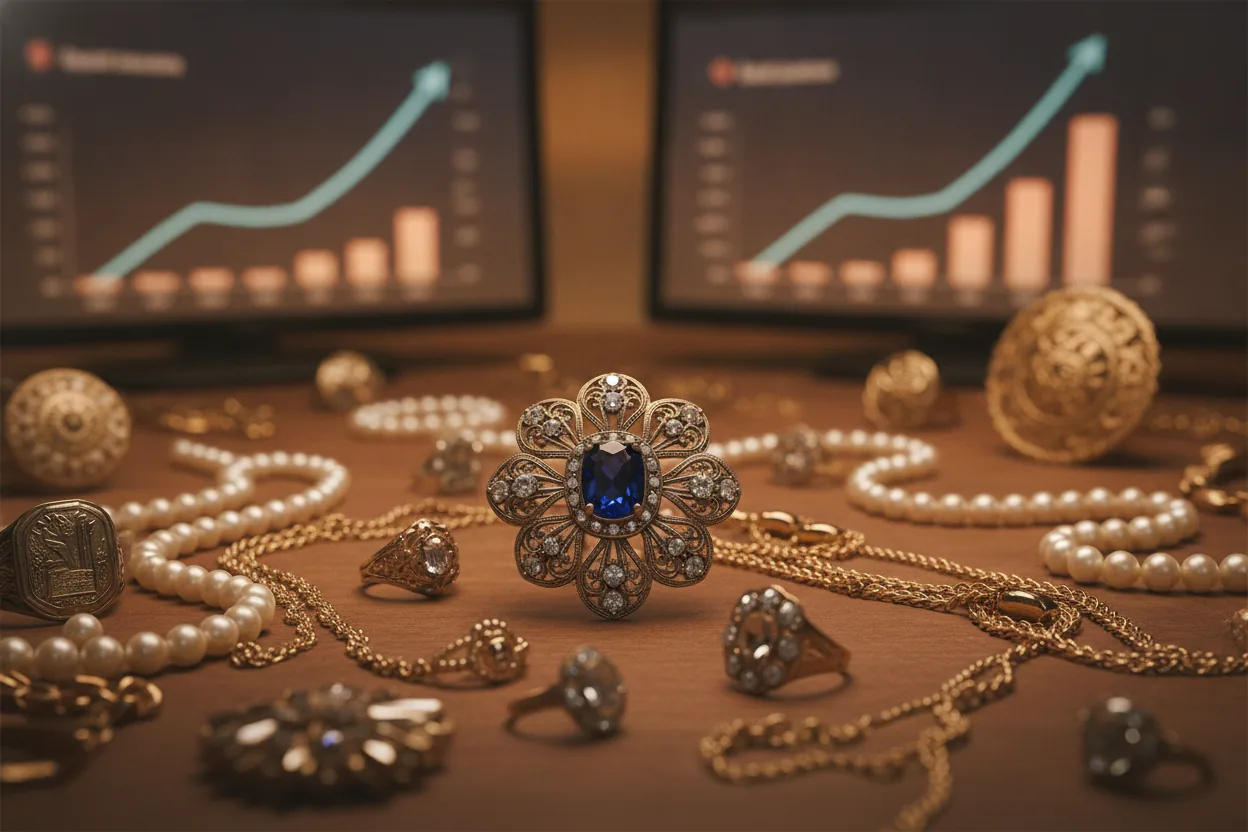
Let’s talk numbers for a second because the shift is real. Whatnot reported that searches for “opulent vintage” climbed 19% recently. That’s notable on its own. But the number that actually matters: searches for brooches and statement jewelry jumped 97%. Almost doubled. And sales of fringe, velvet, and lace are all climbing sharply alongside that.
So what’s going on? I think people got bored. Specifically, people got bored of the clean girl aesthetic, of the boring-on-purpose thing, of the idea that looking expensive means looking like you own nothing interesting. There’s a whole generation of thrifters who grew up on #thrifttok and Depop and who’ve been doing the oversized blazer and vintage Levi’s thing for years now. It works. But it doesn’t always feel like enough. It doesn’t always feel like YOU.
Enter the statement object. A brooch with a story you’ll never fully know. A velvet smoking jacket from some estate sale in the suburbs. A piece of lace that might’ve been part of a wedding dress in 1974 or a curtain in 1988. You genuinely can’t tell, and that’s part of the magic. These pieces carry weight. They carry texture. They carry a kind of visual loudness that you can’t get from a plain cotton tee, no matter how perfectly it’s been cropped.
The move isn’t about maximalism for its own sake. It’s about using one rich, textured, character-heavy piece as the anchor and letting everything else be simple. One find. Whole look.
The Brooch That Started Everything for Me
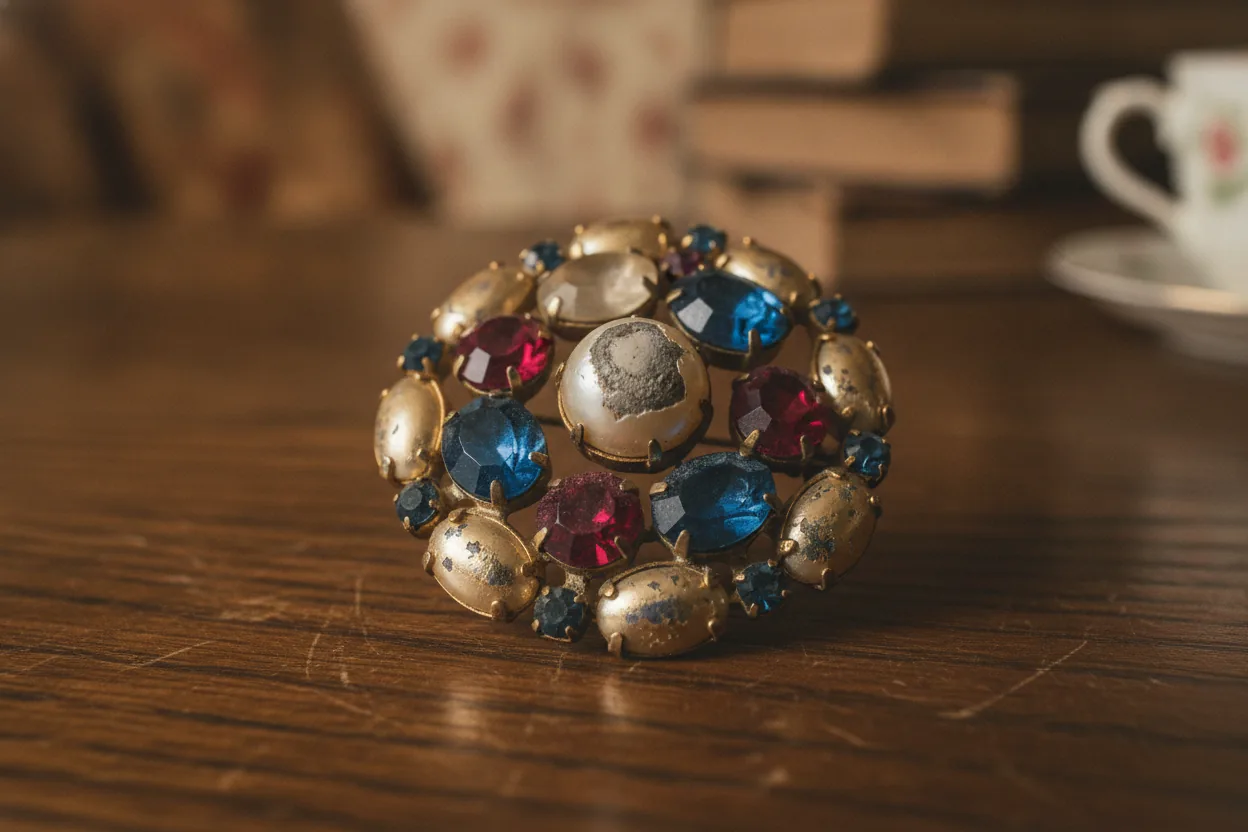
Back to that Goodwill outlet brooch. I want to be honest: I don’t know what it is. I’ve searched eBay for similar pieces. I’ve looked through vintage jewelry forums. My best guess is it’s a costume piece from the late ’60s or early ’70s, possibly Avon, possibly something from a department store counter that doesn’t exist anymore. The stones aren’t real. The gold is flaking slightly on the back. None of that matters.
What matters is what it does when I pin it at the throat of a plain white button-down. Or at the center of a black turtleneck. Or holding together the front fold of a thrifted wool shawl I got for $5 at a church rummage sale in Southeast Portland. It transforms each of those pieces from background to foreground. It makes the outfit about one point of focus. Your eye goes there first, and the rest just supports it.
I started wearing it almost every day for a couple weeks, styling it differently each time, and I noticed something. People didn’t ask me where I got my shirt. They asked me where I got the brooch. They asked me about the stones. They asked if it was my grandmother’s. (It wasn’t, but I love that they assumed it had a lineage.) The brooch became a conversation piece in the most literal sense. It gave people a way into asking about my style, and it gave me a way to talk about thrifting without it feeling like a lecture.
That’s what the best statement secondhand finds do. They open doors.
What Counts as a Statement Object
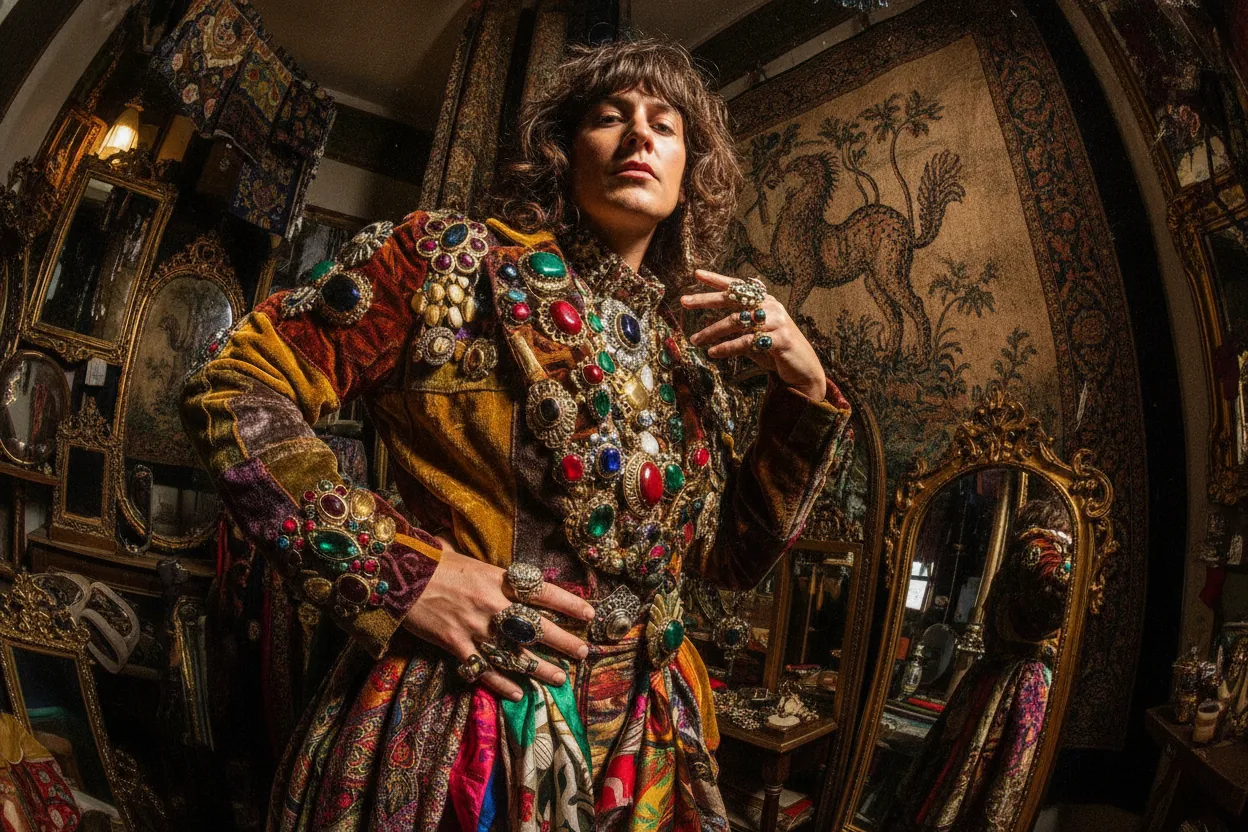
I want to get specific here because “statement piece” is one of those phrases that can mean everything and nothing. In the context of opulent vintage, I’m talking about items that have at least one of these qualities: extreme texture, visible age, unusual construction, or a sense that whoever made or wore this thing had opinions.
Brooches are the obvious entry point. They’re small, they’re cheap at most thrift stores (seriously, check the jewelry case next time, most are under $5), and they punch way above their size in terms of visual impact. Cluster brooches, cameos, art deco geometric pins, enamel flowers, rhinestone bursts. They all work.
But the category goes way beyond jewelry. Velvet is having a real moment in secondhand spaces. I’m talking about velvet blazers, velvet midi skirts, velvet scrunchies even. The fabric reads as rich and intentional in a way that cotton and polyester just don’t. I found a deep emerald velvet blazer at a Value Village in Seattle for $7.99 last month. It’s slightly too big in the shoulders, and the lining has a small tear near the hem. I don’t care. When I throw it over a plain white tank and jeans, it carries the entire look. People assume the whole outfit was planned. It wasn’t. The blazer just does that much work.
Fringe is another one. Fringe jackets, fringe bags, fringe scarves. There’s movement and drama built into the material itself. You don’t have to try hard when your jacket is already doing a little dance every time you walk. I’ve seen fringe suede jackets at estate sales for $10 to $15 that would cost $200 or more if some brand reissued them today. The vintage ones are better anyway because the suede has softened with age and the fringe has that slightly uneven, lived-in drape that new fringe never has.
And lace. Lace collars, lace camisoles, lace-trimmed slips worn as outerwear. Lace has this incredible ability to make any outfit feel like it belongs to a specific person rather than a trend. A $3 lace blouse from a bin store layered under a denim jacket creates a tension between rough and delicate that you couldn’t plan better if you tried.
Connecting the Dots to Subcultures and Eras
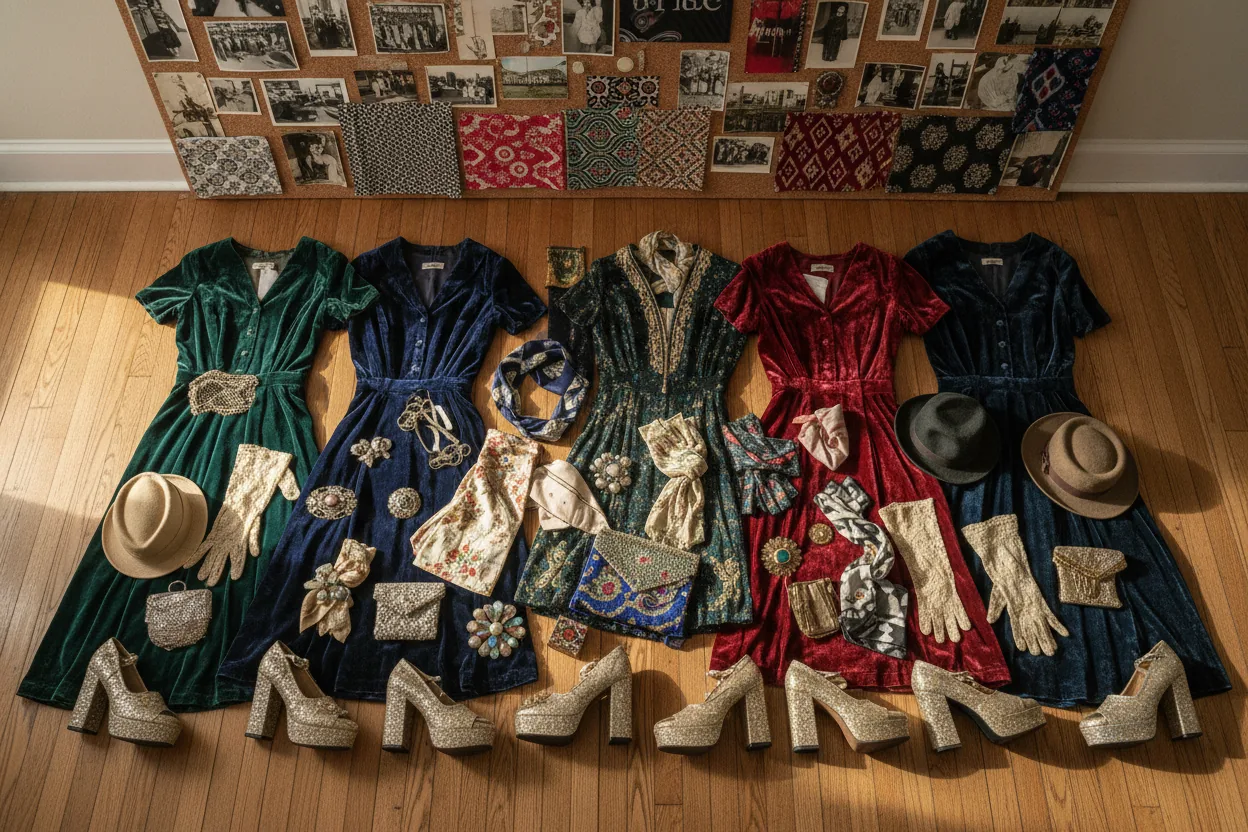
Here’s where it gets interesting for anyone who thinks about fashion as identity rather than just clothes. The opulent vintage move isn’t coming from nowhere. It’s pulling from at least four or five different style lineages all at once.
There’s the 90s grunge revival that never fully went away, where brooches and velvet were already part of the Courtney Love, Hole-era toolkit. Think velvet babydoll dresses, tarnished silver brooches pinned to cardigans, lace slips under flannel. That whole aesthetic was built on thrifted opulence mixed with destruction. It’s the original single-find-carries-the-look strategy.
There’s also the Y2K resurgence, which has pushed people back toward rhinestones, butterfly clips, and anything with a little bit of sparkle or camp. The brooch spike connects directly here. A rhinestone brooch on a going-out top is very early-2000s in spirit, even if the brooch itself is from 1965.
Power dressing from the ’80s is in the mix too. Shoulder pads, bold jewelry, structured jackets with interesting textures. If you’ve been paying attention to the secondhand market, you’ve noticed that ’80s blazers with strong shoulders and interesting fabrics (tweed, boucle, jacquard) are getting snapped up faster than they used to. They’re statement objects. They do the work.
Indie sleaze, twee, and even a little bit of dark academia all feed into this. What they share is a preference for character over cleanliness, for pieces that look like they have a past over pieces that look like they just came off a conveyor belt. The opulent vintage shopper isn’t loyal to one era. They’re loyal to a feeling: that the thing in their hands has lived a life, and they’re about to give it a new chapter.
The Previous Owner’s Ghost
One thing I think about a lot with statement vintage pieces is who had them before. With basics, it doesn’t really cross your mind. A plain gray t-shirt is a plain gray t-shirt. But when you’re holding a brooch with an intricate clasp and stones that catch light in a way that feels deliberate, you wonder.
The brooch I found in the Portland bins: who wore it? Was it someone’s everyday piece, pinned to a work blouse five days a week? Was it special occasion only, brought out for holidays and dinners? Did they choose it themselves, or was it a gift? Did they love it, or was it sitting in a drawer for decades before it ended up in a donation bag?
I’ll never know. That’s the honest truth of secondhand shopping. You inherit objects without inheriting their stories. But I think that gap, that mystery, is actually part of what makes opulent vintage so compelling. You’re not buying a product. You’re adopting an artifact. And you get to write the next part of its story yourself.
I talked to a seller on Depop who specializes in vintage brooches and estate jewelry. She told me that her best-selling pieces are always the ones with visible wear: stones slightly loose, clasps a little stiff, patina on the metal. She said her buyers don’t want pristine. They want proof of life. They want to know the piece was loved before it got to them. I think that’s beautiful, and I think it explains a lot about why this trend is growing. People aren’t just looking for accessories. They’re looking for connection to something they can’t fully name.
How to Hunt for Opulent Vintage Statement Pieces
Okay, practical stuff. If you want to find pieces like this, here’s what’s worked for me and what I’ve seen work for other thrifters who are deep in this space.
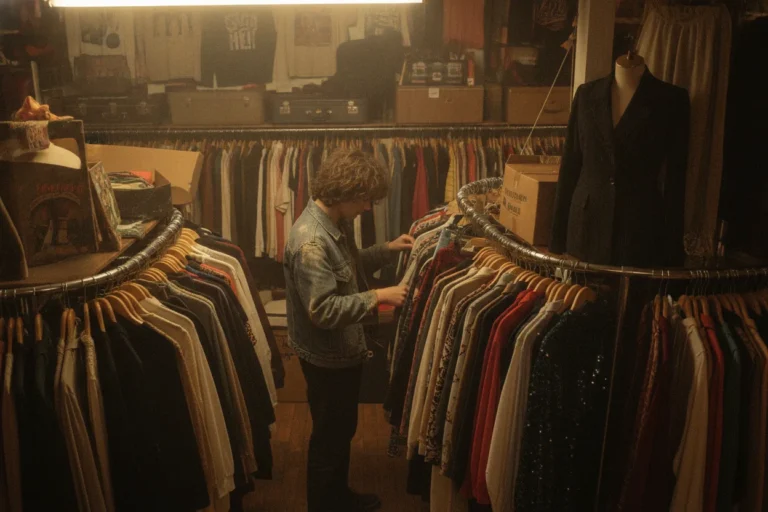
First, adjust where you look inside the store. Most thrifters beeline for the clothing racks. That’s fine. But the statement objects live elsewhere. The jewelry case, obviously. But also the housewares section (brooches and pins end up in random bowls and trays), the accessories wall (scarves, belts, bags with fringe or beading), and the linens area (lace tablecloths and doilies that can be repurposed as collar overlays or layering pieces). I found a hand-crocheted lace collar in a bin of napkins once. Fifty cents. It goes over turtlenecks and completely changes them.
Second, go to estate sales. This is where the really good opulent vintage lives, especially jewelry. Estate sales happen when someone’s home is being emptied out, and the jewelry table is almost always underpriced because the people running the sale often don’t know what they have. I’ve seen art deco brooches go for $2 at estate sales that were listed for $40 or more on Etsy. EstateSales.net is a good starting point. Filter by your area, check the photos, and look for sales that mention “vintage jewelry,” “costume jewelry,” or “estate jewelry” in the listing.
Third, Whatnot and other live-selling platforms are worth exploring if you haven’t yet. The 97% jump in brooch searches is happening there for a reason. Sellers on Whatnot often specialize in categories, and there are vintage jewelry sellers who do live auctions where pieces go for $3 to $15. You can ask questions in real time, see the piece up close on camera, and sometimes learn about the era or maker from sellers who’ve done their research. It’s not the same as digging through bins, but it’s a good supplement, especially for people in areas where thrift stores are heavily picked over.
Fourth, learn a few textures by feel. This sounds weird, but if you’re bin diving or rack flipping fast, your hands will find velvet, silk, and lace before your eyes will. Velvet has a drag to it, a slight resistance when you run your fingers across the grain. Silk is cool and slippery. Lace catches on rough skin. Fringe moves when you disturb the fabric around it. Training yourself to notice texture first helps you pull statement objects out of the chaos faster.
Fifth, don’t overlook damage. A fringe jacket with a few missing strands still has fringe. A velvet skirt with a small bald patch in the pile can be worn with the patch hidden in a fold or even left visible as character. A brooch with a missing stone can be filled with a bead from a craft store or just left empty as a conversation starter. Opulent vintage isn’t about perfection. It’s about presence.
The One-Find Strategy in Practice
Let me walk you through how I’ve been building looks around single statement finds, because I think the practical application is where this really clicks.
Look one: The brooch outfit. Plain black turtleneck from a Goodwill rack, $3.99. Straight-leg black thrifted trousers, $5.99. Black boots I’ve had for four years. And the starburst brooch, pinned right at the center of the throat. Everything is simple and dark, and the brooch is the only point of interest. It reads as intentional, almost editorial, but the whole thing cost under $12 and took me five minutes to put together.
Look two: The velvet anchor. That emerald velvet blazer from Value Village over a white ribbed tank top (thrifted, $2) and light wash vintage Levi’s ($8 at a garage sale). White sneakers. The blazer is doing everything. The color, the texture, the slight oversized drape. Without it, this is the most basic outfit imaginable. With it, people think I have a plan.
Look three: The lace layer. A cream-colored lace camisole I found at an estate sale for $4, worn over a fitted long-sleeve black tee. Dark jeans. The lace creates a visible layer of texture and history on top of something completely plain. It’s giving indie sleaze, it’s giving ’90s slip dress energy, but it cost almost nothing and it took a single piece to get there.
That’s the one-find strategy. You don’t need a closet full of statement pieces. You need one at a time. Rotate them. Let each one take a turn being the loudest thing in the room. Everything else just has to stay out of its way.
Why This Isn’t Just a Trend
I want to push back a little on the framing of opulent vintage as a “trend,” even though I’ve been using that word. Trends imply a cycle. They imply that fringe and velvet and brooches will spike and then fade and then people will move on to something else. Maybe that’s true on TikTok timelines. But the underlying behavior here, the idea of building a look around a single extraordinary secondhand find, isn’t new. It’s actually one of the oldest ways people have ever dressed.
Before fast fashion, before malls, before seasonal trend cycles, most people owned fewer clothes and relied on a handful of special pieces to define their style. A good brooch, a well-made jacket, a piece of lace passed down from a relative. These were the things that made an outfit yours. The rest was functional. The statement piece was personal.
What’s happening now is really a return to that. People are tired of closets full of mid-quality, mid-personality clothes that all kind of look the same. They want the one thing that makes them feel like themselves. And thrift stores, estate sales, Depop, and live vintage auctions are where those things live. Not in a fast-fashion drop. Not in a brand collaboration. In a bin in the back of a warehouse, waiting for someone to reach in and feel something cold, sharp, and interesting under a pile of tablecloths.
That’s not a trend. That’s just how people who care about clothes have always operated. The data might be new. The behavior is ancient.
Scarcity Is Part of the Story
One more thing worth mentioning. The pieces that define opulent vintage — the ornate brooches, the heavy velvet, the real lace, the long suede fringe — these are getting harder to find. The generations that produced and wore these items in their daily lives are aging. Their belongings are entering the secondhand market through estate sales and donations, but once those waves pass, the supply thins.
A rhinestone brooch made in 1958 can only be found once. A velvet blazer from 1973 exists in a finite number. This isn’t about scarcity marketing or trying to create urgency. It’s just real. The pool of genuinely old, genuinely character-rich pieces is not being replenished. Nobody’s manufacturing hand-finished costume brooches with real glass stones in a factory anymore. At least not at the same scale or with the same idiosyncratic charm.
So if you’re drawn to this kind of dressing, this is a good time to be looking. Not because you should panic-buy, but because the hunting is still good. Estate sales are still happening. Thrift stores still have jewelry cases full of $2 brooches that nobody’s looked at closely. The bins still have velvet and lace mixed in with the polyester. It won’t always be this way. But right now, the finds are out there, and most people are still walking past them to get to the graphic tees.
Go to the jewelry case first next time. Pick up the thing that feels heavy for its size. Hold it up to the light. Ask yourself if it could carry an outfit on its own. If the answer is yes, that’s your next look. The whole thing. Built around something somebody else let go of, now yours to wear however you want.
That’s the whole point. One find. Your story. The outfit builds itself from there.